International Money Transfer Limits: Complete Guide [2026]
Many of us need to send money overseas regularly — whether to pay a bill, gift a friend, or send a remittance. But are there limits on how much you can send, and how do high-value or frequent transfers work?
This guide covers the maximum international transfer limits for US bank, how to increase those limits, and providers offering more convenient and affordable ways to send large amounts abroad, like Remitly and Wise.
💡 Quick summary: International money transfer limits
| Topic | Summary |
|---|---|
| 🔄 Transfer limits vary by provider | Different services have different limits – Wise allows up to $1.6 million via wire transfer, while Remitly has a limit of 100,000 USD for verified accounts, and OFX has no transfer limit at all. |
| 🏦 Bank vs. provider limits | Banks often have stricter limits on international transfers compared to specialized providers like Wise or OFX. |
| 🎁 Tax-free transfers | You can transfer up to $19,000 per person per year tax-free as a gift in the US in 2026. |
| 📋 Reporting requirements | Financial institutions are required to report wire transfers over $10,000. |
| ⭐ Great for high-amount transfers | OFX has no set maximum limit, making it a good choice for large transfers, as well as Wise, which lets you transfer up to 20 million USD per local wire transfer or international SWIFT transfer when you pay from your USD Wise account balance. |
Here is most frequently asked questions about wire transfer limits:
| Questions | Answers |
|---|---|
| What is the maximum amount you can send internationally? | The maximum amount you can transfer will depend on your provider. For example, Wise has a $1.6 million limit for wire transfers, while OFX has no transfer limits at all. Remitly has a limit of $100,000. |
| Do I have to pay tax on money transferred from overseas to the US? | You generally don’t have to pay taxes on money received from abroad as a gift or personal transfer, but financial institutions report transactions over $10,000 to FinCEN under the Bank Secrecy Act. |
| How much money can be transferred tax free? | The tax-free limit depends on the nature of the transfer. For example, in 2026, the annual gift tax exclusion is $19,000 per person per year. However, financial institutions are required to report wire transfers over $10,000. |
*Details correct at time of research – 22nd February 2026
Table of Contents
- 💡 Quick summary: International money transfer limits
- Which providers have the highest limits to transfer money abroad?
- How much money can you transfer internationally? 🤔
- The different types of international transfers and sending limits
- ⭐ Best ways to transfer large sums of money abroad
- How to increase the limit of your international transfers
- Maximum money transfer limits without taxes applied 💸
- International wire transfer regulations ⚖️
- How much can you wire transfer without reporting to the IRS? 🤔
Which providers have the highest limits to transfer money abroad?
Let’s get right into the important stuff, with an overview of the international money transfer limits for some of the biggest US banks, and a few specialist providers.
We’ll look at your options for sending high value payments overseas – including some smart ways to cut your costs and get a better exchange rate – in just a moment.
| Bank / provider | International money transfer limits |
|---|---|
| Bank of America |
|
| Chase |
|
| Wells Fargo |
|
| Remitly |
Learn more from here: Remitly transfer limits |
| Wise |
Learn more from here: Wise transfer limits |
| OFX |
|
*Details correct at time of research – 22nd February 2026

As you can see, US banks may have fairly low limits on the amount of money you can send online or in the bank’s mobile app. For higher value transfers you may be asked to visit a branch.
While that can give you peace of mind when sending a high value transfer, it also usually means far higher fees and a more complicated transfer process.
Let’s see how that compares with the specialist services we picked out:
| 💡 Transfer limits to know: | |
|---|---|
| Remitly Review | Remitly has an upper limit of 100,000 USD for verified customers, with transfers to a good range of countries, with payout options including cash collection and home delivery |
| Wise Review | Wise limits are set per transfer, and are generally at least 1 million USD per transaction. With Wise you’ll also get the mid-market exchange rate, and can even qualify for volume discounts on fees when you send a large payment, or send frequent transfers. Wise uses encryption, two-factor authentication, and fraud monitoring systems to help protect customer accounts and payments. Learn more about how Wise keeps customer accounts safe here. |
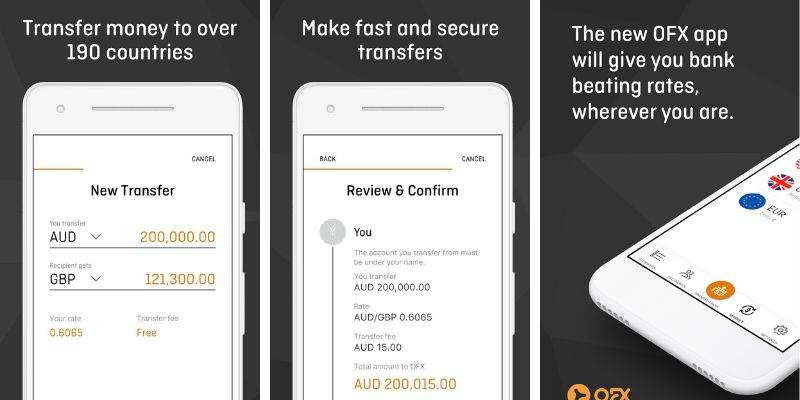
| OFX Review | OFX does not apply its own limits to transfers around the world. However, it notes that there may be limits, particularly when the currencies involved are not freely traded, which are out of OFX control |
How much money can you transfer internationally? 🤔
➡️ There isn’t a specific law that states how much money you can send or receive internationally.
💡 The amount you send will depend on your provider and the destination and financial institutions, and money transfer providers often impose their own daily transaction limits, which can vary significantly.
Some providers may have a limit of $3,000 per day, while others may have no set limit at all.
Additionally, any international transfers that exceed $10,000 must be reported by the bank or financial provider to comply with regulatory requirements and prevent fraud and other illegal activities.
The same rule applies for transfers coming into the US from abroad.
The different types of international transfers and sending limits
So what makes the difference to the amount of money you can send – either with your bank or a specialist provider?
In some cases, the destination and the way you’re setting up your transfer matter.
Other factors can include the type of account you hold – personal or business, standard or premier, for example. Finally, the type of payment you’re making can also mean differing limits.
Here’s a look at some of the typical limits you’ll run into when making an international money transfer from the US.
International wire transfer (SWIFT) limits – online
When sending a high-value payment overseas, banks and providers are required to verify the transfer meets financial regulations in both the US and the destination country – which may involve checking the source of funds or the reason for the transfer.
Banks might be less equipped to handle this process online, resulting in lower limits for online international wire transfers and requiring customers to visit a branch for higher amounts – adding more hassle and potentially higher fees.
Specialist online services tend to be better positioned to carry out compliance checks digitally, allowing them to offer higher transfer limits and a more streamlined experience for high-value payments.
Here’s a rundown of the online limits from the banks and providers we looked at earlier:
| 🎯 Wire transfer limits 📌 | |
|---|---|
| Bank of America | 1,000 USD for personal customers |
| Chase | 25,000 USD for standard account holders |
| Wells Fargo | Set by account type |
| Remitly | 100,000 USD for fully verified accounts |
| Wise | 1.6 million USD per international Swift transfer, 20 million USD if you pay from your Wise account balance. |
| OFX | No upper limit applies |
In branch SWIFT transfer limits
In-branch SWIFT or wire transfers often come with higher limits than online transfers, though this varies by bank and account type.
The downside is that branch visits are more time-consuming and typically incur higher fees, as the added handling costs are often passed on to the customer.
Specialist services like Wise and OFX have no branches, but offer high-value — or even unlimited — transfers online and in-app, with all compliance checks carried out digitally.
International ACH limits
For domestic US payments, ACH transfers are a convenient, low-cost option – but international ACH payments are rarely available from US banks.
Instead, you’re typically directed to SWIFT or international wire transfers, which can be more expensive, especially for in-branch transfers.
Specialist providers can help bridge this gap.
Wise, for example, allows you to fund overseas payments of up to $1 million via USD ACH – here is how it works: you simply send dollars to Wise (you’ll be given the details when you setup your transfer), and they’ll convert and deposit the funds directly into your recipient’s account.
Discounts on Wise fees may also be available for high-value or frequent transfers.
⭐ Best ways to transfer large sums of money abroad
If you’re sending a high value international transfer you may be wondering how to make sure your payment goes through smoothly.
➡️ Here are a few things to do in advance to make sure your payment is hassle free:
- Check your own bank’s payment limits, which can vary depending on how you set up your transfer
- Ask your bank, or the provider you’re using, if any verification checks are required to process your payment – you may need proof of the source of funds, for example
- Make sure your provider account is fully verified, by providing all required ID documents before you start to make your transfer
- Double check you have all the details needed for your recipient, including their full name, bank account number, and any country specific information like a sort code for transfers to the US
Before you set up your international payment with your bank, have a look to see if a specialist service can help with an easier online experience and lower overall costs.
Here are a few to check out:
| 🎯 Providers for sending large international transfers | |
|---|---|
| Wise | High limits of up to 20 million USD, depending on how you want to pay, plus volume discounts on fees, for high value and frequent transfers. Learn more: How to send a large amount transfer with Wise. |
| Remitly | Send up to 100,000 USD per day with a fully verified account – funds can be collected in cash or deposited to the recipient’s own bank |
| OFX | No OFX limits on transfers – you’ll also be able to talk through your payment on the phone with a broker 24/7 |
| Xe | Send up to 500,000 USD online in any 24 hours |
| WorldRemit | Send up to 9,000 USD in any 24 hour period, and pay by card or Apple Pay from the US |
How to increase the limit of your international transfers
Need to send a higher value transfer?
➡️ Usually you’ll find you have a few options:
- Some banks allow you to increase your transfer limit for online payments by visiting a branch – Wells Fargo is one example
- You can often send more with a bank by arranging your transfer in a branch, although this may mean a higher fee compared to their online service
- If you have a specific need to make a high value payment – buying a house for example – your bank may be able to support you on a case by case basis – ask directly to see if they can help
- Some online providers like Wise or Revolut offer multi-currency accounts, which allow you to send international payments easily – and often with higher limits compared to other transfer types
Providers like Wise, Revolut or XE Money Transfer usually offer transparent pricing and rate conversion when sending money overseas. Also, in many cases, transfer limits are displayed more clearly than with many banks.
Maximum money transfer limits without taxes applied 💸
When sending or receiving any money internationally, it’s important to understand the tax implications to avoid penalties and other significant consequences.
The IRS doesn’t place limits on the amount of money you can send or receive internationally, but there are reporting requirements for transactions of $10,000 or more, including multiple payments that total over $10,000 within a short period.
You can also make tax-free gifts up to $19,000 per person, per year, such as cash or other assets like real estate without triggering gift tax. However, if you’re transferring capital gains from selling a foreign property, those gains will be taxed based on whether they are short-term or long-term while inheritances from abroad typically aren’t taxed federally, but reporting requirements apply if they exceed $100,000.
International wire transfer regulations ⚖️
International wire transfer regulations exist to prevent fraud, money laundering, and illegal activity.
To verify a provider is regulated, look for authorization by the relevant regulatory body, usually listed on their official website.
Regulations typically require documentation such as proof of identity, source of funds, and transfer purpose – with higher-amount transfers subject to more rigorous checks.
Specific rules might vary by country but generally cover verifications of payment purpose, the sender-receiver relationship, and source of funds.
Regulations to send international transfers from the US
💡 When sending money from the US, providers must comply with anti-money laundering regulations.
For wire transfers of $3,000 or more, institutions must collect and retain sender and recipient information, and cash transactions over $10,000 must be reported to FinCEN. Compliance checks may also apply to transfers of any size.
Additional documents — such as receipts or proof of source of funds — may be requested, and banks monitor customers attempting to split transfers into smaller amounts to avoid detection.
⚠️ If you hold $10,000 or more in overseas funds at any point during the year, you may need to file a Report of Foreign Bank and Financial Accounts (FBAR) with the IRS.
Rules vary by payment type and value — check the relevant authorities’ websites for up-to-date information.
Rules for receiving money from overseas 📥💰
When receiving money from overseas, it’s important to be aware of certain rules and regulations. For transactions over $10,000, the transfer must be reported to FinCEN under the Bank Secrecy Act to comply with U.S. financial regulations.
You may also need to file forms such as the IRS Form 3520 if the money received is a gift or inheritance.
Additionally, you’ll want to make sure that your funds are transferred through regulated financial institutions to avoid any legal issues. Proper documentation, including proof of the transfer’s purpose and source, may also be required.
➡️💡 Related: Best ways to receive money from overseas
How much can you wire transfer without reporting to the IRS? 🤔
When wiring money, the IRS doesn’t impose specific limits on the amounts you can transfer, but financial institutions must report any transactions over $10,000 in order to prevent fraud.
🎁 Additionally, while gifts under $19,000 per person per year don’t require reporting, exceeding this amount will require you to file a U.S. Gift Tax Return (Form 709) to avoid potential penalties.
What happens when you transfer over $10,000?
💡 When you transfer more than $10,000 internationally, whether from the US to another country or vice versa, financial institutions are required to report the transaction to the IRS.
This is in order to stay compliant with laws such as the Foreign Account Tax Compliance Act (FATCA).
The IRS uses this information to track foreign assets, and failing to report your foreign accounts can lead to penalties.
Depending on your situation, you may also need to submit specific tax forms and it’s advisable to consult a tax attorney who can guide you on the necessary compliance requirements to avoid complications and any unwanted situations.
➡️💡 You can learn more about them here: International wire transfer regulations and taxes. 📚
What is Foreign Account Tax Compliance Act (FATCA)?
The Foreign Account Tax Compliance Act (FATCA) is a U.S. law aimed at preventing tax evasion by U.S. citizens and residents with financial assets held in foreign accounts.
FATCA requires foreign financial institutions to report information about accounts held by U.S. taxpayers to the IRS. Additionally, U.S. taxpayers with foreign financial assets exceeding certain thresholds must report them annually on the IRS Form 8938.
Non-compliance with the FATCA can result in penalties, so it’s essential for individuals and institutions to follow these regulations.
Conclusion: Is there a limit on international money transfers?
There’s no legal limit on international money transfers, but banks and providers set their own limits varying by destination and transfer method.
Bank online payment limits tend to be low — $1,000 for Bank of America and $25,000 for Chase, for example — though higher amounts are often possible in-branch, usually at a higher fee.
Specialist services typically offer higher online transfer limits with transparent, lower fees. Wise allows up to $1 million via ACH or $1.6 million via wire, while OFX has no limits beyond those imposed by US or destination country law. It’s worth exploring specialist providers before transferring, to find lower fees and a smoother payment process.
Useful resources
- Annual Gift Tax Exclusion (IRS): Official info on the 2026 annual gift tax exclusion amount.
- Form 709 (United States Gift Tax Return): IRS details on when and how to file gift tax returns.
- Form 3520 (Foreign Gifts/Bequests): Official IRS page on reporting large foreign gifts or bequests.
- Bank of America Wire Transfers: Bank of America’s own guide on wire transfers, fees and limits (including international wires).
- Remitly Transfer Limits: Remitly’s page showing large transfer capabilities for verified US accounts (up to $100,000).
- OFX – Large Money Transfers: Official OFX page explaining their maximum transfer policy and how large transfers are handled.
- Wise – Transfer Limits (US): Official Wise page for USD transfers
- Wise – Safety & Security: Information on Wise regulation, safeguarding of funds, and account security measures.